






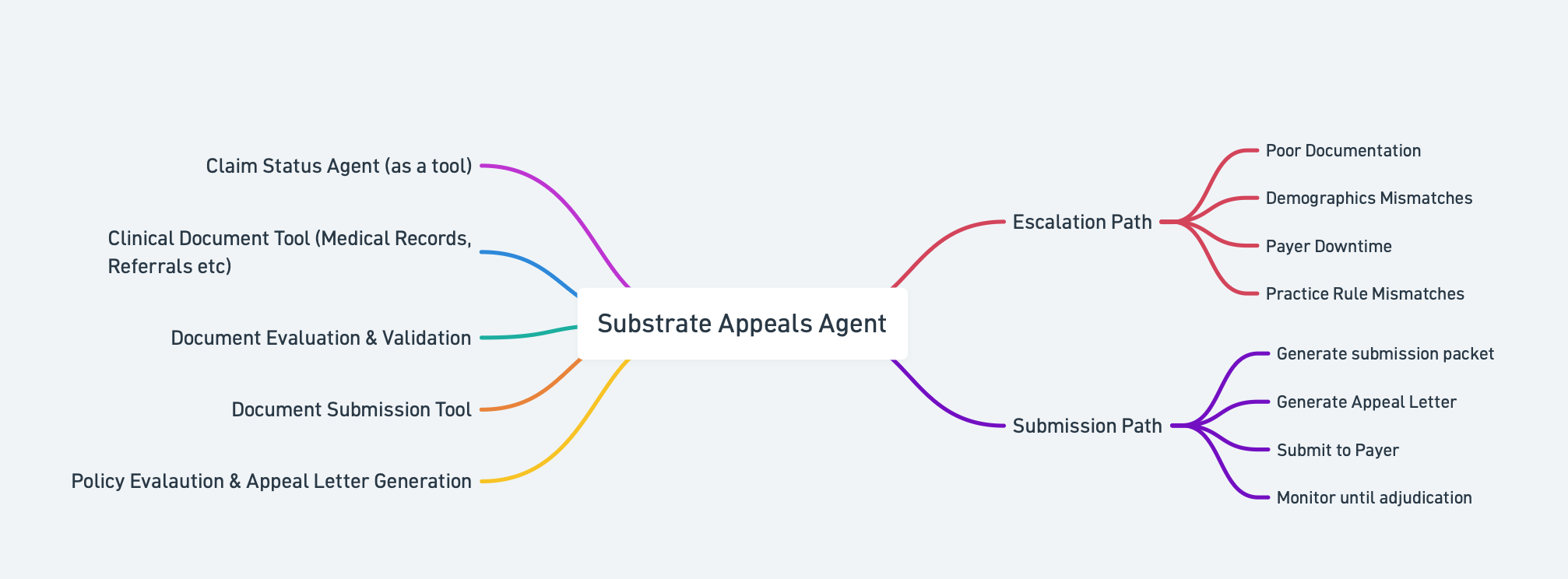
Substrate's Appeals Agent works alongside the Heading Health billing team, acting on pended and denied claims that require a document to be submitted to a payer. It can handle the entire appeal workflow: from downloading relevant documents from the EHR → validating them for correctness → submitting them to payer portals, and tracking all the way until adjudication.
For Heading Health, this means every eligible denial gets fought, not just the ones the team has time for.
The Challenge
High complexity specialties often experience high volumes of pended or denied claims , particularly with a request for medical records. For Heading Health, this was a time consuming part of their revenue cycle. The process was onerous for several reasons:
- Medical Record Requests fail silently: notifications often come by lockbox/correspondence, or not at all.
- Document preparation was manual and error prone: Getting the right documents means logging into the EHR, finding the correct patient encounter, downloading the correct documents, and validating that the documents actually match the claim.
- Lots of copy pasting across portals Each payer portal has a different submission process, and sometimes that process even differs between pended and denied claims.
- No systematic tracking. Once documents are submitted, there’s no automated way to track the outcome.
"Before Substrate, we appealed denials by hand. The backlog put pressure on other RCM tasks, and slowed down the team overall"
- Simon Tankel, founder & CEO at Heading Health
The Substrate Solution
Heading Health was already using Substrate’s Claim Status Agent for no-response claims. This helped quantify medical record request volume. The Substrate Appeals Agent took things one step further, and actually worked those document requests, helping to resolve outstanding claims and denials.
For RCM departments, Substrate is the agentic RCM automation solution that completes mission-critical workflows. The Substrate Appeals Agent brings multiple Substrate agents together into a single, end-to-end workflow that runs automatically, handsfree. Since deploying over a year ago,
- 88% appeals submitted are automatically each month (handsfree)
- > 40% of dollars are recovered (again handsfree)
- 2% lift in net collections attributable to the Substrate Appeals Agent (also handsfree)
End-to-end appeal pipeline

How it works
1. Identifies appealable claims. The system continuously monitors claims, and identifies those that require medical records, usually while they are pended (prior to a denial.
2. Analyzes denial codes and determines next steps. The agent examines CARC, RARC and payer specific denial codes to understand why a claim was denied. Payers often use different nomenclature to describe what they need, and the agent is trained to spot those. When a claim is pended, there is not CARC or RARC code, so this requires understanding the payer specific language.
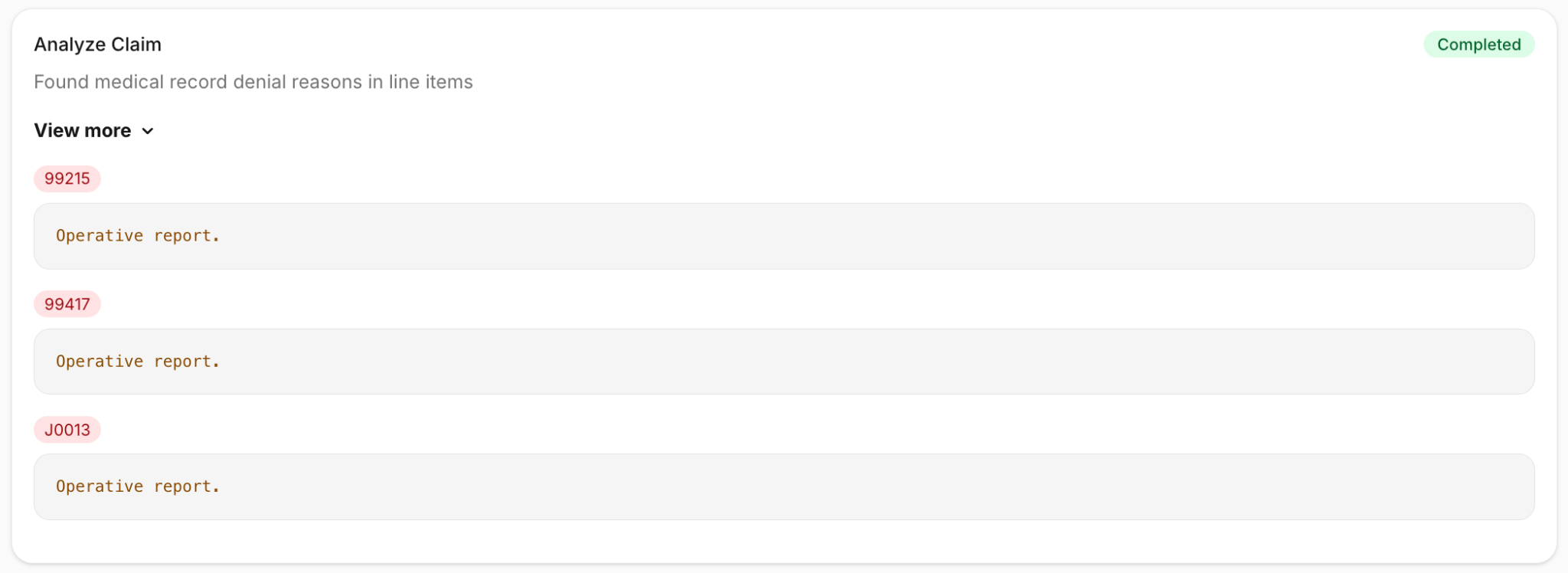
3. Retrieves and validates medical records from the EHR. The agent connects directly to the practice's EHR and downloads the relevant records for each claim, completely handsfree. The billers set the rules, the agent executes on them, and only escalates to a human when it can’t resolve a rule. Does UHC always want proof of prior auth submitted? We’ll escalate when one can’t be found. Will BCBSTX pay even if proof of referral isn’t present? We’ll submit anyway.

Critically, the agent validates that the downloaded records actually match the claim, by checking the demographics the practice has on file, with those the payer has on file. Mismatches are escalated when they can’t be resolved.
"We haven’t had to manually touch most medical record denials or appeals in over a year"
- Simon Tankel, founder & CEO, Heading Health
4. Generates policy-grounded appeal letters: Appeal letters aren’t always necessary when submitting documents. That being said, when they are necessary, the Substrate Policy Agent evaluates the medical record against the payer's specific medical necessity criteria and generates an appeal letter that cites the payer's own coverage policy. This can be tailored to your template, but it also maps clinical documentation to the payer's published medical necessity criteria.

5. Submits appeals to payer portals. The agent navigates to the correct payer portal (Availity, UHC, and others), fills out the appeal submission workflow, uploads the medical records and appeal letter, and submits. It extracts the confirmation ticket number and stores it against the claim for tracking.
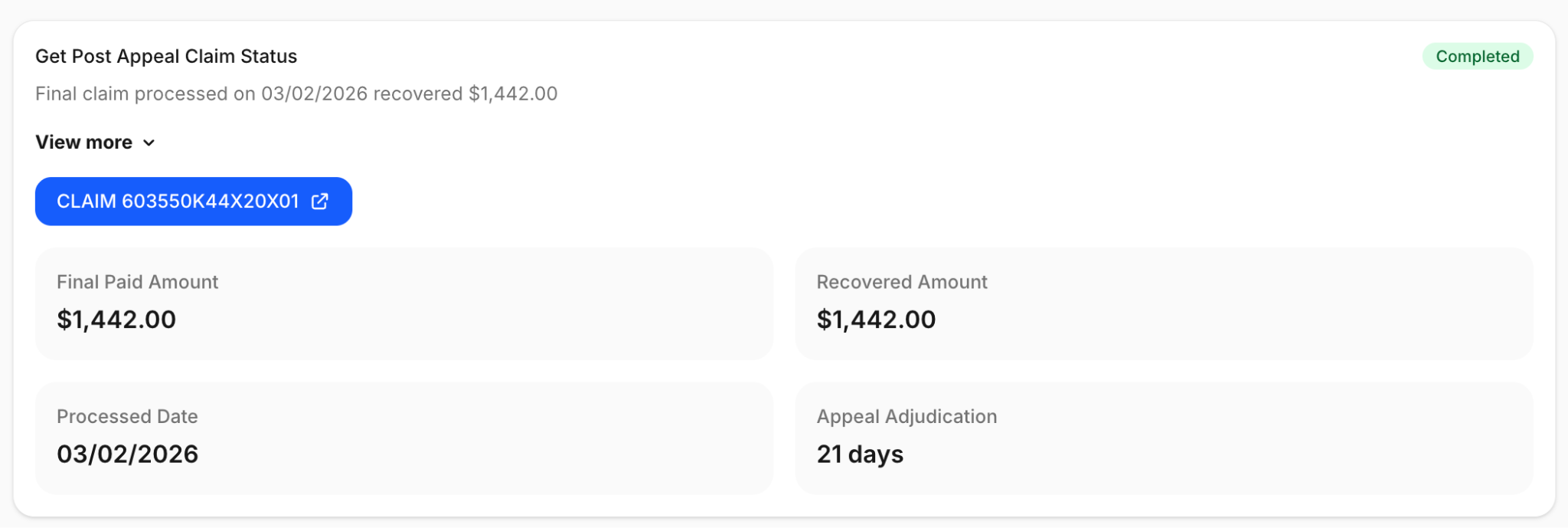
6. Monitors post-submission status. After submission, the system uses the Claim Status Agent and EOB retrieval to monitor whether the payer has processed the appeal. Weekly status checks run automatically for all submitted appeals that haven't received a response, and once adjudicated, success or failure metrics are surfaced on a per claim basis and pushed back into te practice’s system of record.
Auditable and customizable
Every step of the appeal process is logged and visible, including which medical record was used, when it was retrieved, what the appeal letter contained, which portal it was submitted to, the ticket number, the timestamps and more. The Substrate Appeals Agent workflow adapts to each practice or specialty.
Results
Every eligible denial gets appealed
Before Substrate, Heading Health's team had to triage which denials to appeal based on available staff time. High-dollar claims got attention; lower-dollar denials often aged out. Now every eligible denial is appealed, regardless of dollar amount, immediately.
Faster appeal submission
Appeals are submitted within hours rather than sitting in a backlog for days or weeks. Faster submission means faster payer responses, faster detection of trends, and faster revenue recovery.
Heading Health is an outpatient behavioral health practice based in Austin, Texas, providing mental health services including esketamine treatment. They use Substrate to automate revenue cycle management across their payer network.

